

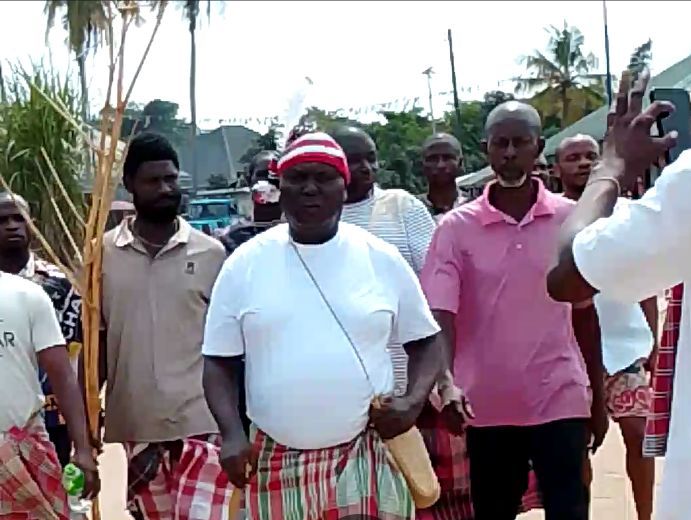
How the eldest son of Akpor Kingdom — a community of deep ancestral seniority, waterfront wealth, and sacred tradition — was governed for forty years by men the gods never chose. And how the true Nyenwe-Ali finally came home.
Rumuokparali: Firstborn Son of the Akpor Kingdom
Before the story of a throne can be told, the land that holds it must be understood. Rumuokparali is not simply one of many communities in the Obio/Akpor Local Government Area of Rivers State. It occupies a position that no other community in the Akpor Kingdom can claim: it is the first son — the eldest and most senior among the ten communities that constitute the Kingdom, by lineage, by tradition, and by ancestral precedence. This is not a title of sentiment. In the customs of Akpor Kingdom, firstborn seniority carries real weight — in councils, in ceremonies, in the ordering of authority, and in the legitimacy of governance.
The community is not merely old in name. It is endowed. Rumuokparali holds extensive waterfront access — both an economic resource and a strategic asset of considerable value to the community and to the state. Its land is fertile, its natural endowments strong, and its potential for agriculture, commerce, and environmental enterprise remains largely untapped. Its youth population is large and energetic — a raw human resource that, given organisation and purposeful direction, represents one of the most significant development assets of any community in Rivers State.
Perhaps most importantly, Rumuokparali possesses something that no government policy can manufacture, and no development budget can restore once it is broken: a deep-rooted traditional governance structure, anchored in sacred law and ancestral covenant. For decades, that structure was violated. Today, it is in the process of being restored — not by human design, but by the movement of the same divine forces that established it in the first place.
Among the ten communities of the Akpor Kingdom, Rumuokparali stands as the first son — the eldest by lineage, tradition, and ancestral precedence. The story of its throne is, in many ways, the story of what it costs a community when its sacred foundations are undermined.
When the Gods Choose a King, No Man May Overrule Them
In Rumuokparali, the stool of the Paramount Ruler — the Nyenwe-Ali — is not filled by human appointment. It never has been. When an incumbent passes on, the Ele Oha, the council of elders, convenes and invites a diviner to commune with the land’s ancestral powers. Through this sacred consultation, the gods themselves name the next Nyenwe-Ali.
This is the only method that is legally and spiritually valid for the installation of a Paramount Ruler in Rumuokparali. No other process — however convenient to men, however politically expedient — carries any authority before the ancestors. The will of the community is expressed not through a show of hands but through the voice of the divine, mediated by a diviner and confirmed by the Ele Oha. It is a system that has governed this firstborn community of Akpor Kingdom for generations. And it is a system that was catastrophically violated in the years that followed the death of Eze Nene Wosu, the last rightfully installed Nyenwe-Ali before Eze Onyema.
Eight Years Old. Crowned by the Ancestors. Guided by the Chief Priest.
In the 1970s, Eze Nene Wosu, the incumbent Nyenwe-Ali of Rumuokparali, passed on. The Ele Oha gathered and the divination was duly conducted. When the ancestors spoke, their verdict was unambiguous: the gods had chosen young Onyema Nnanna Dike-nene — a child of eight years — as the next Paramount Ruler of Rumuokparali. He was crowned and installed accordingly, in full observance of the customs and traditions of the land.
Understanding the weight of what they had placed upon young shoulders, the gods did not leave the child king to stand alone. He was placed under the direct spiritual covering of Chief Wobo Wagor, the Chief Priest of the Owumini deity — the custodian of the sacred rites of the land, and the very office through which the divination had been conducted. It was a divine arrangement: the chosen king, guided by the chosen priest. In the firstborn community of Akpor Kingdom, the succession was not merely orderly. It was sacred.
Under this covering, the young Eze served faithfully for three years, fulfilling the most sacred obligation of the Nyenwe-Ali — the feeding of the gods of the land at their ancestral shrines of Ruhu Ali Rumuokparali and Igbogo Onurugu. The gods received his offerings. The land was at peace with its ruler.
For three consecutive years, the young Eze performed the sacred rites that only the true Nyenwe-Ali may perform — and the gods of Rumuokparali received him. Not one of the impostors who occupied the stool in the forty-plus years that followed could do the same.